Saturday, 22 June 2013

Fledgling Success - Visit 16

I was back out on Rathlin on 17 June doing my second Twite survey visit of the spring around the southern half of the patch. Once again no new species for the year were recorded and very few fresh migrants were noted.  However, lots of species appear to be having a good breeding season, with lots of chicks and juvenile birds to be found.
 
In a turn up for the books, this included a MOORHEN with 3 tiny chicks! From bogey bird to breeding bird...
 
Also seen with chicks or fledged young today were: Rock Pipit, Goldfinch, Oystercatcher, Lapwing, Eider, Robin, Common Gull, Lesser Black-backed Gull, Herring Gull, Shag, Grey Heron, Wheatear, Mallard, Coot, Greylag and Tufted Duck.
 
In other news, contrary to my last report, I was pleased to find that around 6 pairs of Sand Martins have indeed nested in the Doon Bay cliffs. The only 'new' birds seen were some early returning Curlew and Redshank at Ushet Lough which unfortunately are likely to be failed breeders from further afield. 
 
Elsewhere on the island, the survey team have turned up a small number of additional Twite territories, which is great news following the destruction of a breeding site by the recent gorse fire. 
 
A Pomarine Skua was seen from the north section of the patch today by a colleague and can be added alongside Garden Warbler, Siskin, Whinchat and Hen Harrier, to the list of species I've 'missed' this year, which have occurred on patch.


Monday, 17 June 2013

Racking them up!

Working as a warden on the Kilcoole Little Tern Conservation Project has meant that I've been living on patch since the first week of May & added quite a few species to the year list. It has also meant that access to the internet on a laptop has been few & far between, hence the lack of recent updates.

In any case here's a run down of the highlights from 1st May-17th June:

(114) Kingfisher: single seen on several dates from 3rd May.
(115) Common Tern: first seen on 6th May, plentiful thereafter.
(116) Arctic Tern: regular sightings since 8th May.
(117) Roseate Tern: first seen on 9th May & present most days thereafter until late May. Peak count of 20+ on 10th May. Best Spring passage ever for them on the patch. Great views of some landing in amongst the Little Terns!
(118) Marsh Harrier: 3 different female/immature birds seen over weekend of 10th-12th May.
(119) Arctic Skua: dark phase birds seen offshore on 10th & 19th May.
(120) Short-eared Owl: one present in general area & showing well around wardens camp from 12th-19th May. Have seen summering birds here over past few years but never any indication of breeding.
(121) Storm Petrel: one on 12th May, 3 on 12th June & 8 on 13th June.
(122) Sanderling: Northbound passage kicked off on 13th May with peak counts of 70 on 16th & 71 on 26th May.
(123) Puffin: one South past The Breaches on 17th May & 13th June. Patch record count of 18 flying South past The Breaches on 11th June. Must be small numbers breeding on Bray Head & Wicklow Head?
(124) Long-eared Owl: amazing views of one hunting along the track by The Breaches railway bridge on the evening of 17th May. Bird of the year so far!
(125) Carrion Crow: a pure individual seen on 21st May amongst foraging flocks of Hoodies. Two hybrids also seen around that time.
(126) LITTLE RINGED PLOVER: one in Webb's field on 1st June showing well near the wardens camp. Only managed a few record shots. It hung about for half an hour or so then disappeared promptly after being chased by the local Ringos. Only the second I have seen on the patch (first was on 9th April 2000!).
(127) HOBBY: one flew East out to sea over the Little Tern colony on 5th June. Watched until it was a dot on the horizon line, heading straight for Wales! My sixth patch record.
(128) Little Gull: one 2cy flew North on 7th June.
(129) Knot: one 2cy flew North on 7th June.
(130) Cuckoo: female near the Little Tern colony on 16th June.
(131) Grey Plover: one 2cy flew North on 17th June.

Other sightings of note:
Pink-footed Goose: one in Webb's field from 25th May-4th June associating with an injured wild Icelandic Greylag Goose.
Common Scoter: several small flocks migrating North.
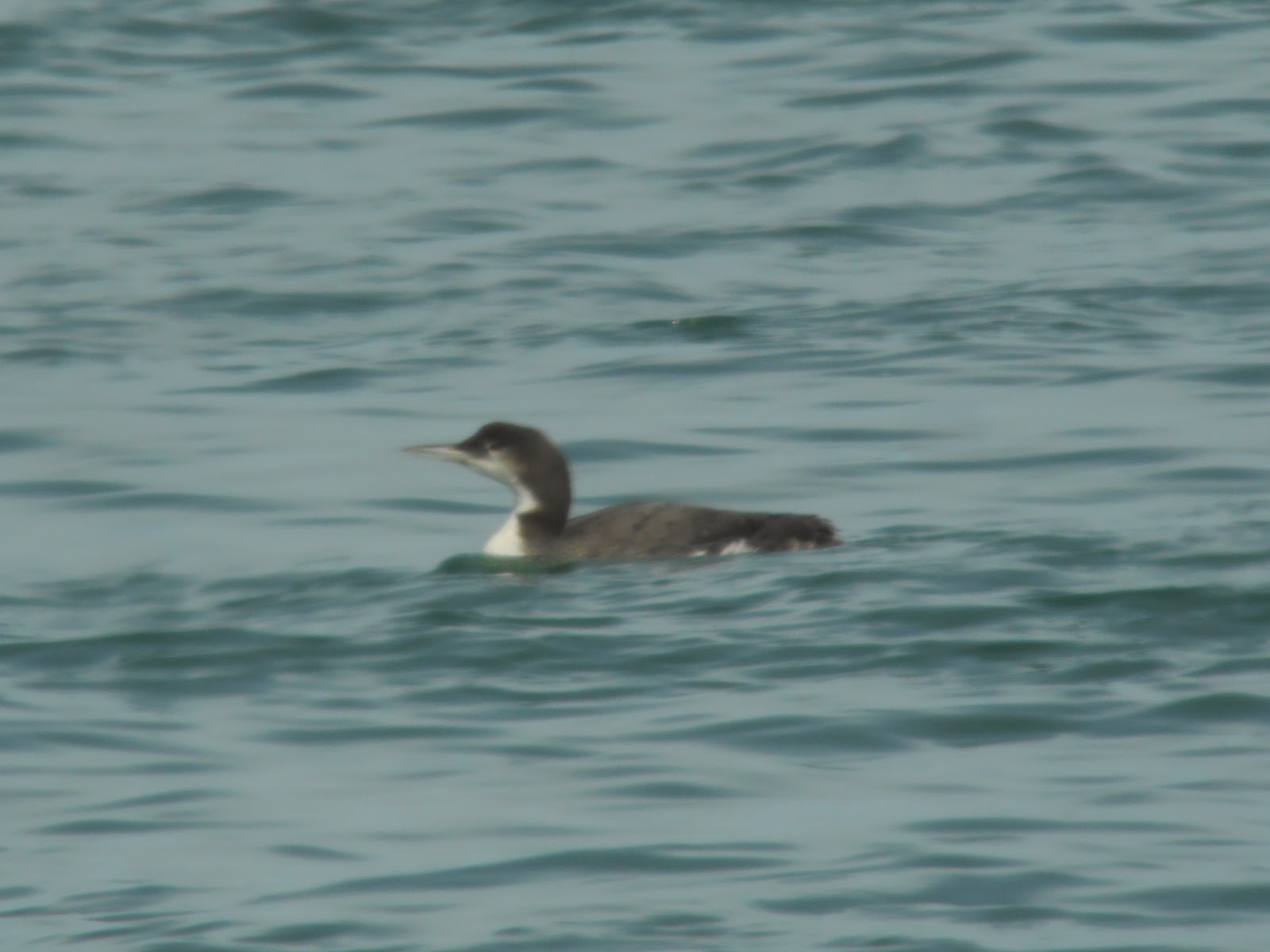
Great Northern Diver: 5+ individuals seen offshore throughout May & into June. Spring seems to be the best time for GND's on the patch.
Manx Shearwater: peak passage of c.2,150 North past The Breaches between 07:15-08:45 on 13th June. Great views close inshore.
Merlin: one female/immature on 1st May (have seen more Hobbys here in May than Merlins!).
AMERICAN GOLDEN PLOVER: the 2cy bird was present in Webb's field up to 3rd May.
Mediterranean Gull: one 2cy on 19th May, 5 (various ages) on 7th June & one 2cy on 10th June.
Sandwich Tern: peak count of c.110 in Webb's field on 3rd May (no orange bills!).
Swift: some large flocks descending on Webb's field lagoon during cloudy/humid weather such as c.300 on 13th June. Oh for a Pacific amongst them! ;)
Stock Dove: pairs seen around Webb's & Stringer's farmland.
Yellow Wagtail: second male of the Spring in Webb's field on 3rd May, associating with Wheatears.
Wheatear: good count of 44 on 1st May.
Grasshopper Warbler: one on 1st May.
Reed Warbler: one singing in Webb's field on 8th & 17th June. Two singing at Ballygannon reedbed on 15th June,
Yellowhammer: flock of 8 seen around Webb's farm.
 
Spring passage of waders was quite good this year. Generally small numbers of birds present at any given stage of the day but throughout new birds were constantly seen dropping in & out. Peak day counts as follows: Golden Plover (65), Curlew (6), Whimbrel (86), Black-tailed Godwit (45), Redshank (2), Common Sandpiper (1), Turnstone (21) & Dunlin (120). The majority of the Dunlin appeared to be schinzii with just a handful of identifiable(ish) arctica & alpina noted. Lots of intermediates! Some of the Ringed Plover moving through also appeared to be from Arctic regions with a peak count of 13 'Tundra' types on 17th May. These birds were noticeably darker, fresher & more attenuated/slimmer than the local breeders. They also had a habit of arriving in a tight-nit flock & departing together again the next day!

So all in all it's been a good Spring on the patch leaving me on 131 species, 166 points & 84.91%

Short-eared Owl
Roseate Tern just outside the Little Tern colony fence!
Pink-footed Goose
Great Northern Diver (2cy?)


Little Ringed Plover in Webb's field on 1st June #patchgold

Long-eared Owl

Sunday, 16 June 2013

Winter Hangover?

It was a strange weekend down at Ballycotton.

Today I found a bird I really did not expect at this time of year, A drake Surf Scoter flying by with ~ 50 common scoter. It pays to seawatch from the cliffs. And that is pretty much all I did this weekend really.

Prompted by various skuas, including an Adult Long Tailed, seen during the week by Paul Moore,
I was down on Saturday in the hopes of an early seawatching season begining. And it actually was not bad!
Storm petrel fell first, with a reasonable passage of Manxies. And this was followed up by (at last) some Common terns. Then the star bird of the day, the first Cory's Shear of the season loped west.

All in all a nice little clean up.
A quick check of the lake and beach produced sweet FA.

Number of species 132. Score: 184. Relative score: 78.08%

Lets hope some more lovely sea passage goes on soon.


Monday, 3 June 2013

Burnt Out - Visit 15

For the first time this year a visit to the patch failed to add any new species to the year list. In fact very few new birds were seen this weekend as compared to last.  However, the main reasons for my visit on Saturday 1 June were to have a look at what damage the recent gorse fire has had on nesting birds and to enjoy the goings on of the Rathlin Sound Maritime Festival.

Gorse fire


After seeing footage and images of the gorse fire during the week, I wasn’t so sure about the reported claims that “no important bird nests had been lost”.  Sure enough, even from the ferry it was quite clear that the fire had torn right through the Twite breeding site I had discovered only last week.  There was no sight or sound of the birds and the gorse bush under which I suspected a nest, was well and truly scorched.  This is terrible news for what is Northern Ireland’s rarest breeding finch.  Let’s hope they try again somewhere else on the island.
 
 Former Twite territory
 

It was great to see so many people visiting the island today. Only a few weeks ago I was the only passenger on the ferry!  Around the patch the few common warblers that were seen, mostly seem to be breeding birds now.  A pair of Pied Wagtails with freshly fledged young must have wondered what all the fuss was about in Church Bay as they tried to feed along the strand. 
                                                                                                         Clippers in Church Bay
 

 Home time...
 
 Heath Spotted Orchid

Juvenile Stonechat

The highlight of the day was finally managing to get a few images of 1 of the 2 presumed Common Redpolls seen today – the colouration and size are striking in the field - real brutes. 
 
Score remains on 106.3%
 

Common Redpoll 


Thursday, 30 May 2013

Little Update

Only 2 species added to the year list since the last update, namely Spotted flycatcher and Puffin.
Still no Common Tern yet, which is pretty mind boggling. With June approaching, Storm petrel and Balearic Shearwater will be on the cards, but a few weeks away.

Species 128. Score 169. Comparative score 71.71%.

Wednesday, 29 May 2013

Moorhen at last! Visit 14

I thought it would never happen, but nearly 5 months into the patch birding year, I finally saw a Moorhen (108) on Rathlin on Saturday 25 May! Migration seems to be on the wane for some species but a few waifs and strays are still turning up.  A missed opportunity this week was failing to connect with a female Hen Harrier that has been reported from several spots around the patch since mid-week.

Finally!

Decent numbers of common warblers were spread across the usual locations and a Spotted Flycatcher was in Church Valley snapping away at insects from a fence post.  As I was leaving this area a Woodpigeon (109) sped across the sky and circled the valley a number of times before heading off west (I only saw my first of this species on the island last autumn).  
Plenty of finches have taken a liking to the fields behind Church Bay, which are currently full of wildflowers.  In amongst these were at least 4 Common Redpolls.  As to where these birds are heading is anyone’s guess, but there seem to be a few around the Western Isles in Scotland and other migration watch points in NW Ireland at the moment.  In other finch news, a breeding plumaged Twite was observed singing and visiting a probable nest location.
I reported last week that the Black-headed Gull colony had failed, so I was pleased to discover a new colony today that held around 25 nesting pairs.  Several other species were also seen with hatchlings or fledged young including Song Thrush, Lapwing, Starling, House Sparrow, Stonechat, Mallard, Coot and Greylag.  Only 2 Sand Martins were seen around Ushet Lough and appear to have changed their minds about breeding in the cliff face nearby.
Patch day totals: 27 Sedge Warbler, 25 Willow Warbler, 9 Whitethroat, 2 Blackcap, 1 Chiffchaff, 1 Goldcrest, 1 Spotted Flycatcher, 15 Goldfinch, 30 Linnet, 20 Lesser Redpoll, 4 Common Redpoll, 1 Twite, 1 Moorhen, 1 Woodpigeon, 2 White Wagtail, 2 Wheatear, 1 Dunlin, 1 Chough, 35+ Swallow, 9 House Martin, 2 Sand Martin
Score now 109 species, 135 points or 106.3%

Thursday, 23 May 2013

That's that then.

With migration basically a struggle throughout Cork this Spring it's no surprise that nothing unexpected turned up on patch. I suppose I should be thankful that at least the expected managed to make it. A Spotted Flycatcher turned up back on territory before I had heard of one at a migration spot. Then the next day a Whitethroat was singing. Luckily two Whimbrel flew over calling one evening, I was starting to think I was going to have to string them if they didn't pass over soon.
    And that's that until the summer post breeding dispersal of Sedgies. Ok I might get a June Hobby or a
flyover Crossbill but at 98.79% anything else will be a big bonus. I had suspected that I omitted some species
in my tally from earlier in the year but I didn't expect that I had left out 12 species hence the jump to 82sp
and 96 points.