Saturday, 3 May 2014

Rathlin Island - April Update

During April I managed four day trips to Rathlin Island and as was the case last spring, a nice trickle of migrants put in an appearance, which included 2 patch ticks, a great selection of raptors and no less than 25 year ticks!
 
On the first visit on 5 April, I spent some time hanging around the Coastguards Hut/Ballyconagan area in search of raptors which soon paid dividends when a female Hen Harrier (69) put on a show before flying high over the north cliffs being mobbed by Ravens.  Male Merlin (70) and Sparrowhawks (71) also put in appearances, as did a Peregrine and several Buzzards!  Also in this area were at least 3 Twite (72), including a singing male and several chipping Snipe, some of which were flushed by the hunting harrier. I’ve always liked the look of this area, you could just see something like a Gyr Falcon sitting on a post here one day… but for now I’m more than happy to have caught up with what was only my 2nd patch record of Hen Harrier; a species I managed to dip last year.
Elsewhere, a noticeable arrival of finches had taken place with several small flocks of Goldfinches and Linnets (73) bombing around the patch.  The gardens and hedges produced a small number of Willow Warblers (74) and Goldcrests (75) and a single Redwing by the pub.  The only other year tick of the day was a single Swallow (76) over the “walled garden” above Church Bay.

Totals, 5 April: 75+Goldfinch, 9 Goldcrest, 4 Chiffchaff, 12 Willow Warbler, 1 Hen Harrier, 3 Twite, 2 Chough, 14 Linnet, 1 Redwing, 1 Merlin, 3 Wheatear, 1 Swallow
The next visit on 18 April, was one of those days which keeps me coming back to Rathlin.  As ever, my first stop of the day was to the West Pier, where bobbing about amongst the seals, were 3 Common Sandpipers (77).  Then in Church Valley, one sallow bush had about 15 Willow Warblers in it! Elsewhere in the valley were 2 Blackcaps (78), numerous Wheatears and 3 Lesser Redpolls (79). During the walk towards the East Light, a flock of about 10 Brent Geese (80) were seen heading west out at sea.  I made my way down to the top of the cliffs behind the lighthouse wall and took up position for a seawatch.  Streams of Gannets and large auks were moving west and Black-headed Gulls and Kittiwakes were milling around and feeding at the base of the cliffs.  Eventually a few Manx Shearwaters (81) were seen, but there was no sign of the hoped for Puffins.
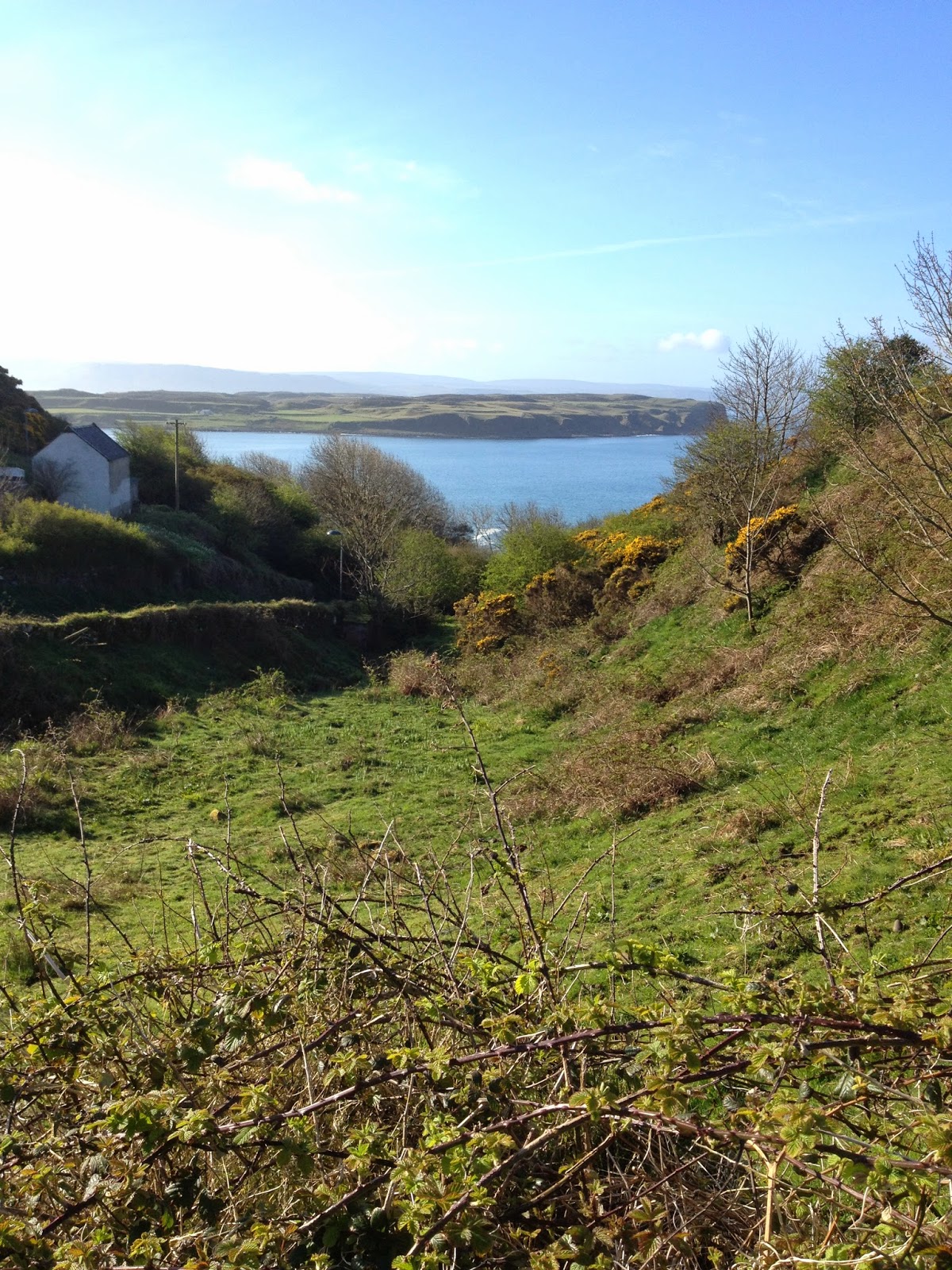
Lower section of Church Valley

Willow Warbler

Wheatear
 
I was about to head back down the track towards the east end gardens, when something made me head over to scan the sea through the gully just to the west of the lighthouse compound.  As soon as I arrived at the fence, an enormous shape flushed from a ledge on the cliff face just yards below me, I watch as it made several lumbering wing beats and dropped in height, before rising up to eye level, turning left and cruising along the top of the cliffs in side on profile - a GOLDEN EAGLE (82)!  I made it to be a sub-adult as it had a few remnants of white in its upper tail feathers.  This is my 2nd patch record, following a near adult seen on 15 April, 2012. Unfortunately, a full-pelt steeplechase along the cliff tops failed to produce any further sign of the bird, so I didn’t manage any photos of this one. Or indeed see any Puffins.
There is a nice vantage point overlooking the east end gardens, where I stood in a bit of a daze for a while and made some half-hearted attempts to scan the gardens, when a Stonechat popped up onto the fence ahead of me, I didn’t even put the bins on it until it flew off showing a white rump! It stopped briefly on the fence at the other side of the field – a cracking male Whinchat (83), a patch tick no less! It was in exactly the same field I saw a Yellow Wagtail last spring.
 

Whinchat
 
My day got even better when the rapidly drying out Ballycarry Pool, finally produced a “different” duck in the form of a drake Gadwall (84) alongside a female Wigeon and 6 Teal.  This was the second patch tick of the day and shows there is hope yet to find what I’d really like to see here (e.g. Garganey or Green-winged Teal).
Elsewhere, the first White Wagtails of the year were seen in Mill Bay and House Martins (85) and Sand Martins (86) were new in at Ushet Lough.
Totals, 18 April: 10 Brent Geese, 4 Chiffchaff, 70+ Willow Warbler, 3 Common Sandpiper, 1 Chough, 23 Linnet, 25 Goldfinch, 3 Lesser Redpoll, 1 Merlin, 25+ Swallow, 40+ Wheatear, 5 Manx Shearwater, 1 Golden Eagle, 1 Whinchat, 2 Blackcap, 1 Gadwall, 1 Wigeon, 3 White Wagtail, 3 House Martin, 5 Sand Martin
I was joined on my next visit on 20 April by my father and things got off to a bright start, with 2 Twite feeding in Ballycastle Harbour before the ferry across.  Once on the island, things were lively enough in Church Valley, with a Woodpigeon (87) bolting out of the trees and the first Sedge Warbler (88) of the year bursting into song.  Migrant numbers elsewhere were much lower than on the last visit and the day was eventually saved by a nice male Grey Wagtail (89) feeding in a mound of manure at the back of Mill Bay.  The day ended with a few pints in the bar.
Early Purple Orchid

House Sparrow nesting above the pub door!
 
Totals, 20 April (North half only): 30+ Willow Warbler, 4 Common Sandpiper, 1 Chough, 1 Woodpigeon, 4 Lesser Redpoll, 2 Sedge Warbler, 15 Wheatear, 2 Blackcap, 1 Chiffchaff, 10+ Swallow, 3 White Wagtail, 1 Grey Wagtail
It was back to full patch birding mode on 27 April, which started with a memorable ferry crossing in flat calm conditions through hundreds of Kittiwakes, Guillemots and Razorbills and the occasional Puffin or Manx Shearwater.  The Puffins (90) were officially added to the year list later that day from Ushet Port.
Church Valley was again full of phyllosc warblers and it wasn’t long before a reeling Grasshopper Warbler (91) and 2 singing Whitethroats (92) were seen.  Redpolls have been much less prevalent this spring, with virtually all records being of flyover birds, but a group of 7 Lesser Redpolls were seen here today.  Numbers of Sedge Warblers and White Wagtails were also up to 13 and 9 respectively this visit. 
Once again, waders are conspicuous on the year list by their near absence, so it was great to finally add Dunlin (93) and Whimbrel (94) for the year at Mill Bay.  A flock of 30 or more Rock Pipits feeding in a field here were noteworthy and no doubt would have contained a littoralis or two if it weren’t for them all being heavily back lit.
All was it should be down at Ushet Lough, with breeding Common Gulls, Lapwings and Oystercatchers on territory and making a right din. Sand Martins look like using the same breeding site as last year in the cliffs at Doon Bay.  The small group of pines at the south end of the lake held a very dull acredula type Willow Warbler.
Ushet Lough
 
Totals, 27 April: 2 Chiffchaff, 38 Willow Warbler, 11+ Swallow, 13 Sedge Warbler, 1 Grasshopper Warbler, 2 Common Whitethroat, 1 Merlin, 1 Whimbrel, 20 Wheatear, 1 House Martin, 2 Chough, 3 Dunlin, 9 White wagtail, 10+ Sand Martin
So the month ends on 94 species (1 more than at this stage last year), 116 points or 76.8%

Monday, 7 April 2014

Purple Patch – Larne Lough update

Life ‘Post-Crane’ around the Larne patch has been predictably dull, with just the occasional oddity turning up and a slow trickle of migrants arriving through March.  However, in the past week or so, things have really livened up, with some birds actually troubling the bonus points column on the score sheet!  Since my last update in early February, I have made more visits to Glynn Station and Sandy Bay than I care to remember and have had no end of trouble trying to find certain ‘common’ species.  Yet, somehow it all seems worthwhile when the patch serves up birding gems like Kumlien’s Gull and Glossy Ibis!
 
The only addition to the year list in February following the Crane was a drake Shoveler, found loitering off Glynn Station with Wigeon on 22nd, which I’m treating as a patch tick – although I do have a vague recollection of seeing two females at Glynn many moons ago, but don’t seem to have noted it down anywhere.


There has been no shortage of gulls to check through during the past month or two, with a major arrival occurring in mid-February and numbers generally building since then.  I made a rough count of all the gulls visible from Glynn Station on 20th February and tallied 1200 Black-headed Gulls, 800 Common Gulls, 300 Herring Gulls, 25+ Great Black-backed Gulls, 5 Mediterranean Gulls and 3 Lesser Black-backed Gulls. A grand total of over 2300 gulls, but this figure could easily have been doubled had all the gulls in the north end of the lough been counted.  Paying close attention to the gulls also revealed the spring arrival of Med Gulls, with at least 12 birds being seen on at least one occasion (8 x adults, 2 x 2nd sum & 2 x 1st sum) around the patch.  By mid-March several adults could be seen displaying off Glynn Station and most will hopefully stay to breed on the nearby islands, which are currently heaving with gulls and terns.
No further year ticks were seen until 9th March when I finally caught up with a Kingfisher at Glynn Station.  Later that day, on my first foray to Curran Point of the year I managed two more with 15+ apparently fresh in Meadow Pipits and a female Stonechat.  On my second visit here on 17th March, a nice male Wheatear was present.  This site definitely seems capable of attracting passerine migrants.


Other early spring migrants were picked up around the patch on predictable March dates – Black-tailed Godwits on 14th, the first Chiffchaff singing at Bank Road on 16th, Sandwich Terns off Glynn Station on 29th and a Blackcap at Glynn Lagoon on 30th.  Although a Whimbrel seen and heard off Glynn on 19th March had most likely wintered there.
 
Little Egret and Water Rail proved surprisingly difficult to get onto the year list. The former was not encountered at until 14th March and an early morning stake out of the private lagoon at Glynn was required for the latter the following day.


March is normally one of the best months of the year in Larne Lough, as in addition to the mass arrival of gulls, there is also a nice build-up of ducks, geese and waders and this year proved to be no exception. Peak counts from Glynn Station included: 120 Brent Geese, 145 Redshank, 6 Greenshank, 100+ Curlew, 129 Eider, 63 Goldeneye and 58 Red-breasted Merganser. As well as occasional Red-throated and Great Northern Divers. 
I was beginning to think the most unusual gull sighting of the winter was going to be an adult Kittiwake seen roosting off Glynn Station on 19th March, but an evening trip to the local garage on 31st soon changed that idea.  Driving home along the harbour highway, I noticed a nice collection of gulls loafing at the Inver River mouth at high tide.  I pulled onto the hard shoulder and was scanning the flock with my bins, when I was stopped in my tracks by a most welcome tail pattern! I focussed in on the bird – an adult Kumlien’s Gull, but something wasn’t quite right, it was at the dark end of things for Kumlien’s, appeared rather chunky and most strikingly appeared to have an all dark bill.  At that moment I realised I had no scope with me, so after a quick dash home, I was soon back viewing the bird from the Bank Road side of the lough as it drifted further away on the outgoing tide.  I managed good views and took some shots through the scope.  The eye was also dark (ok for adult Kumlien’s), the breast and neck heavily marked/streaked and the bill did have some blotches of yellow on it, suggesting it may have been stained or caked in mud.  Later that night, once confirmed as a Kumlien’s by various other gull enthusiasts, I updated my patch score sheet to discover it was worth a whopping 6 points!

 
I arrived home from a work visit to England late on 3rd April to discover that the Glossy Ibis first seen outside the patch boundary in January had been seen off Glynn Station.  Obviously this necessitated a 7am visit the next morning before work, but there was no sign, although the first Willow Warbler of the year was in full song at the station.   
My next visit to Glynn Station on the evening of 6th April, will live long in the memory.  I arrived to find a couple of local birders casually chatting about a Pintail – I raised my bins and right at the mouth of the river was a stunning drake, which I quickly told them (not that they cared much) was the first time I had ever seen this species in the lough.  Shortly afterwards, the original patch birder himself - Cameron Moore arrived to get some shots of the bird. He then told me he had seen the Glossy Ibis there that morning.  Whilst enjoying views of the Pintail a small grebe popped up into my field of view.  I got onto it through the scope and stopped Cameron mid-sentence and said you might want to take a look at this grebe!  A smart Slavonian Grebe almost in full summer plumage was feeding just yards away from the Pintail!  This was as good as a patch tick, as my only previous record was of a dubious long range bird several years ago.  I have seen summer plumaged Slav’s in Strangford and Lough Foyle before, but never at such close range.  An absolute belter.


I ventured off to view the private lagoon from the main road, hoping to finally see the Glossy Ibis.  After half an hour searching there was no sign, but I did manage to year tick Coot!  I returned to the platform at Glynn to find that another couple of birders had arrived to see the grebe.  As all present stood taking in views of the grebe and Pintail, local birder Brian shouted out “hold on, isn’t that the Ibis just off the point?” Err hell yea it is!  Appearing as if from nowhere, the Glossy Ibis was now standing within feet of the feeding Pintail and Slav Grebe…


Having birded around Larne for many years, this sort of thing just does not happen here.  Whatever next I asked Cameron, “Pelicans” he replied.
All this action leaves me on 102 species or 131 points for the year.
Shirley Dunlop, Gerard McGeehan, Cameron Moore and Brian enjoying all the goings on at Glynn last night...

Saturday, 5 April 2014

100 !!!

It has been a struggle but today I hit 100 species with two WILLOW WARBLERS and two distant MANX SHEARWATERS. My points total is only 121 which shows that rarities are practically non-existent on my patch, so far at least.
Apart from picking up a few migrants the species of note in the last couple of weeks were, WHOOPER SWAN (4), WHITE-FRONTED GOOSE (30+), GREYLAG GOOSE (3) and most surprisingly TUFTED DUCK (1) seen flying into the Common Scoter flock.

Eamonn
Species 100, Points 121, Comparative 82.31%

Sunday, 30 March 2014

Not so Mad March

Just a quick update. Only managed a couple of visits to Kilcoole during March since my last post on the Tree Sparrow patch ticking bonanza so nothing major to report on.

The brent flock finally produced an adult bernicla on 8th March, the first Dark-bellied Brent I've seen there all winter (normally one regular bird about most years). Otherwise, a nice ringtail Hen Harrier was the only other species of note that day.


Adult Dark-bellied Brent Goose

Back down again on 15th March with the BirdWatch Ireland Kildare Branch. An enthusiastic gang of 30 or so participants enjoyed nice views of singing Skylarks, displaying Lapwing, hovering male Kestrel, five soaring Buzzards, a super flock of c.180 Golden Plover (some developing nice black underparts) and plenty of Light-bellied Brent Geese, Greylag Geese & Whooper Swans. Also scored my first migrant of the year during the outing, a Chiffchaff (97) singing quietly away in the Sea Buckthorn. No sign of any of the hoped for Wheatears on the day but it was good to meet up with and chat general patch nonsense(!) with fellow PWC participant, Michael O'Donnell.


Kildare Branch outing © Caroline McDonald

Have been offshore this past week, seabird surveying on board the R.V. Celtic Explorer during the annual Blue Whiting Acoustic Survey but will be back on patch come mid-April to clean up on Spring migrants (hopefully!).

Until then... 97 species, 123 points, 60.59% comparative score, 790 BirdTrack records & 15 complete lists.

Wednesday, 26 March 2014

Coliemore - 24th of March

After a slightly ambitious attempt last year, I went with a smaller patch for this year. My intent is to focus on seawatching from Coliemore, as well as picking up a migrant or two in Dylan's Park. Having got Sooty Shearwater and a few Skuas from here last year, the main targets are Black Tern, Sabine's Gull and with a little bit of luck hopefully a Long-tailed Skua or Grey Phalarope.

The Patch
Met Eireann had forecast some nice south-easterlies for Monday and (for once) they were right - winds averaging around F5 to 6, gusting up 30+ knots at times... and good amounts of rain. Unfortunately it proved to be a rather quiet afternoon:

-Fulmar..................(31 south)
-Gannet .................(1 north/18 south)
-Kittiwake .............(1 north/48 south)
-Guillemot ..............(7 south)
-Ra/Gu ..................(12 south)
-Black Guillemot ....(4 north)
-Oystercatcher .......(4 south)
-Turnstone ..............(1 south)
-Purple Sandpiper ..(4 south)

Also present but not counted were Common Gull, Herring Gull and Great Black-backed Gull. Birds on the islands included two more GBBG's, plus some Shags and Cormorants on Maiden Rock, with Lamb Island hosting 3 each of Herring and GBB Gull and 46 Cormorants/Shags. A Pied Wagtail fed around the viewpoint at Coliemore Harbour. That gives a total of 14 species so far. Hopefully things will pick up a bit with tyhe easterly winds expected over the weekend and into next week.

Seawatching Hours: 2
Total: 2

Sunday, 23 March 2014

Winter meets Spring - Rathlin Visit 3

I made use of the early morning ferry to Rathlin on Friday 21st March to spend the entire day slogging around the patch in search of year ticks and early spring migrants.  As is typical for this time of year, there was a nice mix of wintering stragglers and incoming breeders, which resulted in a further 11 species being added to the year list (including all 4 predicted at the end of my last post).
 
The Long-tailed Duck continued its long-term residency in the harbour alongside a male Red-breasted Merganser.  From the West Pier 2 Chough (58) were seen tumbling along the cliff tops in the strong SW winds.  The gull contingent in Mill Bay now included the first Black-headed (59) and Lesser Black-backed Gulls (60) of the year and a single Great Northern Diver remained offshore. 
Craigmacagan Lough once again produced some of the highlights of the day.  Whilst scanning the water, I heard Redwings (61) calling overhead and looked up to see 4 birds land on a nearby gorse bush before quickly disappearing. A male Reed Bunting (62) was calling from the reed bed, one of at least 6 males seen during the day.  As I approached the cattle grid at the south end of the lough, I noticed a bird scuttling across the track just a few yards in front of me.  Before I had even raised my bins I knew it was a Water Rail; it was that close (63)!  Nevertheless, this did provide a pleasant flashback to my day in the sun on Saltee a few years back!  The bird scrambled towards the nearest ditch, allowing just enough time to get a pic on the phone.  It’s always a treat to see this species out in the open.


Water Rail
Twice more between Craigmacagan and Ushet Loughs I saw pairs of Chough flying by, each time carrying nesting material.  It’s impossible to tell if today’s sightings relate to more than 2 birds - perhaps this was just the regular breeding pair performing an elaborate courtship flight across the entire length of the island!
 
A small number of Lapwing (64) have once again returned to Ushet Lough and as I watched these flying around, a Snipe (65) flushed from nearby.  I only realised this was a year tick when checking through my Birdtrack records earlier today! Also at Ushet were lots of gulls and Oystercatchers noisily setting up territories for the breeding season.  A male Goldeneye was on the water.
Ushet Lough
I had planned to walk down to the South Light, but upon seeing waves crashing against the cliffs, sending spray higher than the lighthouse, I decided against it.  Instead, I walked the sheltered coastline between Ushet Port and Doon Bay.  In amongst the many sandy inlets and pools here were 60+ Teal and over 30 Shelduck. As I watched 4 Buzzards hovering high above the cliffs, a Peregrine (66) hurtled by overhead, causing a commotion amongst the nearby Common Gulls.  I finally connected with my target bird for this stretch of coast at Doon Bay – 2 male Wheatears (67) seen skipping from boulder to boulder ahead of me.  Much in the same location as the first birds last spring!
I also checked the East Light gardens, then found myself up by the coastguards hut and had a quick search of Church Valley.  Only one further surprise was on offer – a single Chiffchaff (68) flitting about the willows by the Church.  Also of note was a great swarm of Meadow Pipits seen flying across the valley here.
Scores 68 species, 81 points or 53.6%

Friday, 21 March 2014

Patch Introduction - Holy Cross & Carriganore, Waterford

The Patch!
I have been following the Patchwork Challenge on Twitter and reading the blogs and decided that it was time to get involved! I had planned to enter a Waterford coastal patch but a new baby at home means time is limited this year. So to plan B.
Daily walks with my two dogs at a popular site just outside Waterford City (an IDA business park) has become my patch over the last 5 or so years. It's not the most productive or picturesque of patches but a lot of time spent here has seen me build up the patch list to 70 species. For the purpose of the challenge I have extended the patch boundary to the north to include the nearby area of Carriganore (site of WIT Sports Campus and also the National Biodiversity Data Centre) 
The patch comprises of 6 or 7 large fields divided by mixed hedgerow/gorse and mature trees, a small conifer plantation, a reed lined pond and a stubble field in winter. The area at Carriganore has a small wooded area and views over the River Suir which I hope will produce some bonus species over the course of the year.
The area has provided many birding highlights over the last 5 years. December 2012 produced 5 Waxwings and a week later in January 2013 I found a Brambling feeding in the stubble field with a mixed finch flock (the only bird on the patch that was "twitched" by local birders!) A brief Reed Warbler in August 2011 remains the only patch record. Wheatears have become regular in September/October over the past few years. Confirmed breeding of both Treecreepers and Spotted Flycatchers last summer was satisfying. Other notable birds have included singles of Whooper Swan and Whitethroat. 
The Pond - breeding Moorhen, Sedge Warbler & Reed Bunting can be found here most years

My main aim this year is to track down the species I feel should be on the patch list but have eluded me over the years - Siskin, Yellowhammer & Pheasant are top of my wish list!