Showing posts with label Iceland Gull. Show all posts

Thursday, 6 April 2017

Larne Lough and Rathlin Island - March 2017

It has been typically dull around Larne Lough lately, the gulls are now settled on the islands for the summer, the terns are trickling back as a smattering of other spring migrants begin to put in an appearance. The first year tick of the month were some Lesser Redpolls on the Alders along the railway line at Curran Road on 4th, saving me the indignation of having to check garden feeders. My usual jaunt around Larne usually includes a seawatch from the leisure centre in the hope of a Fulmar - I can't understand how they are so difficult to see when they breed in numbers nearby. Eventually much squinting towards the Maidens paid off when 2 Common Scoter flew by on 4th.  I will be on Manxie (and Fulmar) watch from now on.
 
The first Black-tailed Godwits arrived on 5th March, with numbers building to 15 on 18th before a flock of 40 appeared at the mouth of the Inver River on 23rd March - which isn't a regular site for this species.  Numerous Snipe and the odd Jack Snipe were on the move during the month. The feral Greylags made their first appearance at Glynn on 12th, but unfortunately did not manage to persuade the long-staying Greenland White-front to join them - though there is time yet!  Sandwich Terns were seen feeding off Sandy Bay and roosting at Glynn from 17th. A fairly standard return date.  Chiffchaffs were in song along Bank Road on 26th, but my usual site for Wheatear has not produced the goods so far.

Sanderling with Dunlin, Sandy Bay

Jack Snipe with Ballylumford Power Station in the background

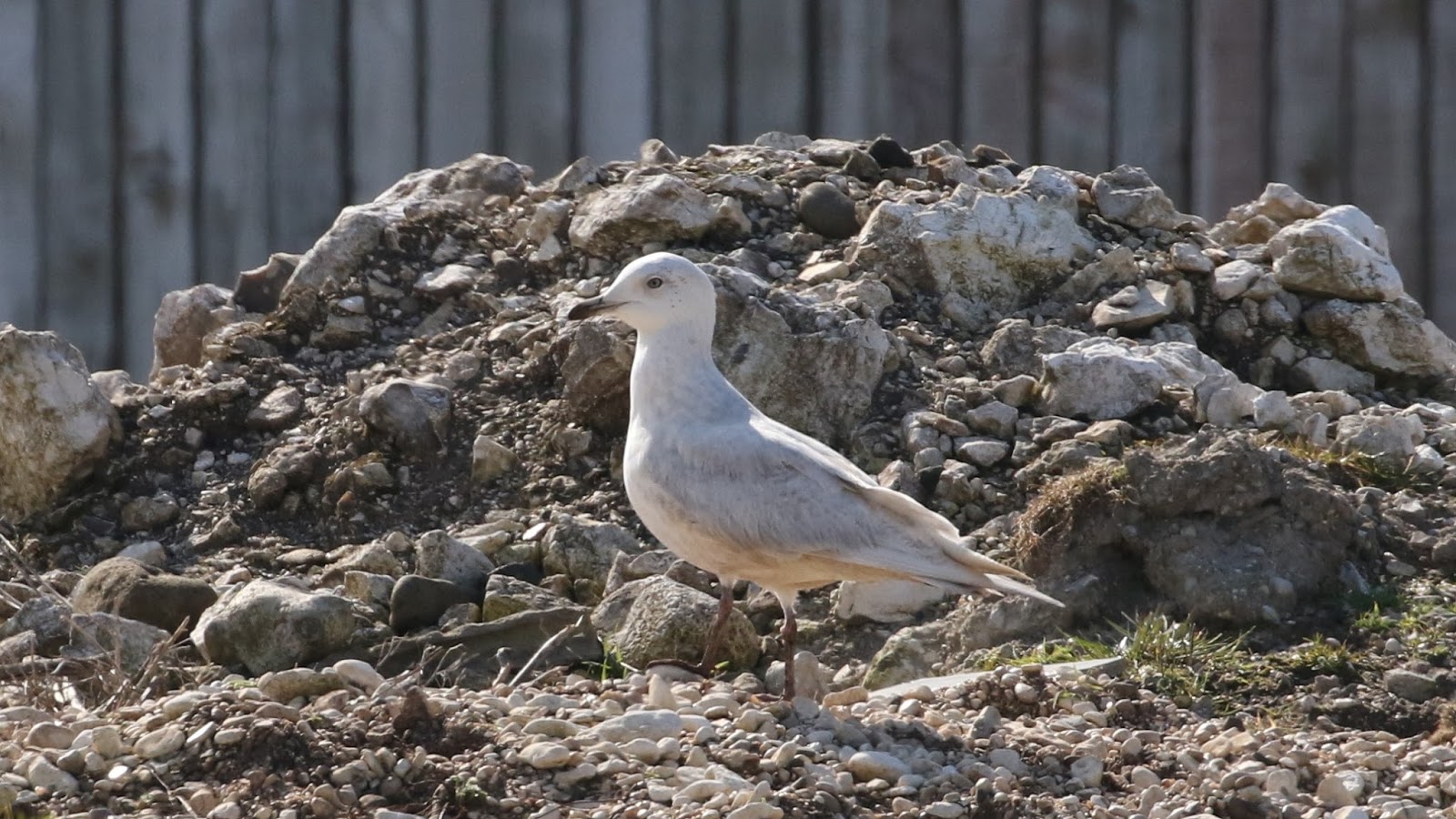
As time moved towards the end of the month my attention turned to Rathlin and I managed another visit on 25th March, which turned out to be rather productive.  Things looked promising as I made by way up the hill at Church Valley, as numerous Goldcrests were flitting about above my head, easily totalling over 40 by the end of the day. The first Peregrines of the year were back at a regular breeding site, as were a couple of pairs of Twite. Near the East Light, as I checked around the cattle feeders for Chough, a large white blob entered my view.  A rather tatty, but glorious Iceland Gull. Only my third patch record! Into Church Quarter and two Woodpigeons bombed overhead, charging about gormlessly as only they can, before nearly impaling themselves in a blackthorn.  A classic early spring migrant on Rathlin and a most welcome year tick. Five Chiffchaffs were also noted.

A scan of the small sandy beach beside the harbour failed to produce any new waders for the year, so I decided to check a few Rock Pipits on the seawall for pink-wash. In return, a red-tail sprang onto the rocks beside me - the adrenaline rush began, was this finally it? Well, no... but a nice Black Redstart, just the second documented Island record and the first since 5th May 2013.  I was delighted, but only managed distant record shots as getting any closer would have disturbed the seals and they put up with enough of this already.  The south end of the patch produced the first Chough of the year and 2 Whimbrel at Doon Bay. A promising start to Spring!
 
 
Gannet action from the ferry

Over 40 of these on Rathlin on 25th March

First butterfly of 2017

Dappled light

Iceland Gull

Pair of Teal

Black Redstart

Black Redstart (taken from the ferry on my way home!)

Meadow Pipit

Close up Mipit

Chough, Doon Bay

Say my name


Irish Hare

Larne Lough additions in March: Lesser Redpoll, Common Scoter, Black-tailed Godwit, Greylag Goose, Sandwich Tern, Chiffchaff
 
Rathlin Island additions in March (since last update): Woodpigeon, Chough, Black Redstart, Chiffchaff, Iceland Gull, Blue Tit, Lesser Redpoll, Whimbrel, Peregrine, Twite, Coal Tit, Pheasant

Monday, 15 December 2014

Fun and Games in Larne

If my last update from the Larne Lough patch seems a long time ago, that’s because it was!  You can read it here – and since that post not a lot has been happening, a year tick every now and again, with little in the way of quality.
 
My struggles are highlighted by the fact that my first year tick since 23rd June were some Sand Martins (117) in a mixed flock of hirundines feeding over Glynn rugby club lagoon on 9th August.  I had never knowingly seen this species around Larne before, so I was more than happy to see them! 
 
From early July I kept a look out for passage waders, which eventually produced a few year ticks - a Knot (118) on 16th August and a juvenile Curlew Sandpiper (119) on 24th September were new for the year, the latter only my second ever patch record!  Elsewhere, peak counts of 25 Greenshank (22/9), 32 Snipe (15/11) and 88 Lapwing (6/12) were notable.  A Jack Snipe (120) was found at Glynn on 15th November, which became my first record of this species on the patch for almost 5 years!  I managed to successfully twitch an unexpected Grey Plover at Sandy Bay (121) early morning on 30th November - they are normally seen in small numbers off Glynn Station much earlier in the autumn.  A single Whimbrel is currently wintering around Glynn.  It was not all good news on the wader front as I managed to miss out on Spotted Redshank and Ruff.
 
Knot

 
Curlew Sandpiper
 
Redshank
 
Seawatching was also a struggle, but with (extreme) perseverance produced some year ticks.   The first Arctic Terns (122) of the year were seen from a short seawatch on 24th September.  This species occasionally appears at Glynn Station during spring, but all I saw here this year were a handful of ‘red-billed’ Common Terns.  Some decent onshore winds on 15th October had me in the shelters in Chaine Park for first light.  Despite the bewildered glances of some locals, this proved to be an excellent decision as several Whooper Swans (123) and Common Scoters (124) were seen as was my first ever patch Bonxie (125)!  To finish things off nicely for the day, the first Kestrel (126) of the year was seen above the coast road.

It has been a great year for ducks on the patch and the autumn period once again threw up the occasionally oddity.  Three Common Scoter were off Glynn Station on 16th October – no doubt some of the birds seen on the seawatch the previous day. A female Shoveler was present on 19th July and the first returning Goldeneye was back on the early date of 4th August.   A male Scaup was present off the station on 12th September, with 2 there on 28th.  The interesting run of Pintail records continued, following the on/off appearance of a male (in various states of moult) throughout the summer.  An eclipse male was seen on 29th October, followed by an adult male and 2 female types which have been omnipresent since 15th November. 
During the past few months Larne Lough has once again proved itself as one of the best sites in Ireland to see Goosander.  An eclipse male was present off Glynn Station on 12th September (local breeder?), followed by an adult male there on 11th November (same bird?).  Two females were seen late evening on 5th December followed by a high count of 4 females the next day.  The adult male at least is still lurking around the lough somewhere.  One of my best finds of the autumn was a Slavonian Grebe seen distantly from Glynn Station on 22nd November.  I wonder is it the same bird seen here this spring.  Whatever its provenance, it looks set to spend the winter on the lough – the first bird for many years to do so.
Eclipse male Goosander

Female Goosanders
 
It has also been a good year on patch for Little Gulls, I managed to find my 4th bird this year on 1st September at Sandy Bay.  Mediterranean Gulls are present on the patch all year round, though it appears only two birds are overwintering this year – an adult and a 2nd winter.  Best seen at the mouth of the Inver River.  The most exciting recent development has been the regular sighting of two Sandwich Terns around the mouth of the lough, an adult and 1st winter.  I picked them up feeding well offshore on 30th November during a seawatch, associating with hundreds of Kittiwakes and small gulls which gather to feed on sprat in and around the Maidens at this time of year.  That evening they appeared on the rocks at Sandy Bay and have been observed here occasionally ever since.  These are the first wintering records for Northern Ireland away from County Down.
 
Juvenile Med Gull

Little Gull
 
There was much fun and games on 13th December when, whilst scanning offshore from Glynn Station, I picked up a white-winged gull flying across the mouth of the harbour towards Islandmagee.  As it looked set to cruise around distantly above Ballylumford power station, I decided to drive around to see if I could get better views.  Despite it being possible to throw a stone from Larne Harbour on one side of Larne Lough to Ballylumford on the other, it takes a good 20 minutes to drive from Glynn round to the north tip of Islandmagee and when I arrived there was no sign of the bird.  It eventually appeared flying around above the docks on the other side of the lough!  I watched it through the scope as it landed on one of the harbour floodlights beside a Herring Gull.  Views were atrocious but the outline of the bird and its size compared to the Herring Gull suggested it was an Iceland Gull (127).  So it was back in the car for the half hour drive back to Larne.  No sign from the harbour gates at Sandy Bay or the road out to Curran Point.  Then just as I was about head home, it appeared over the car and flew towards the ferry terminal.  Sod it I thought and followed it in.  As I explained myself to security, I could see the bird feeding in the wake of a docking ferry and moments later found myself being escorted (surprisingly not off the premises) down to a gateway beside the ramp for a better view.  So there I was standing in the near dark watching an Iceland Gull in Larne Harbour as passengers flooded past me in their cars.  All this for a lousy 2 points!
 

Iceland Gull
 
The next morning, it took a loaf of Kingsmill to finally pin the bird down as a 1st winter Iceland Gull and obtain some decent shots.  The only other year tick since my last update was Lesser Redpoll (128) but the less said about this the better!  With the year drawing to a close, there might still be time for one or two additional species, but as it stands scores are 128 species or 166 points.